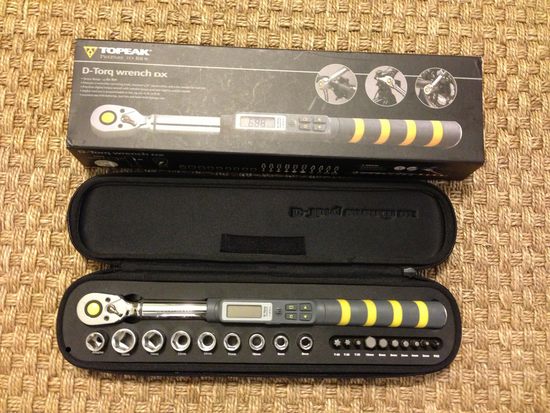
Review: Topeak D-Torq DX Bicycle Digital Torque Wrench

Topeak D-Torq Wrench DX

If you have a carbon fiber bicycle, or any carbon fiber parts on your bike like a seatpost, handlebar, stem or anything else, you’re going to need a torque wrench.

And the frustrating part is that you’re going to need to either buy an expensive adjustable torque wrench, or you’re going to have to scout out a bunch of different torque specific wrenches, because your seatpost might need to be tightened to one specification, and your handlebars to another.

It is extremely important to use a torque wrench because with carbon fiber components, if you overtighten, you can ruin the component (or your whole bike!) or put your life in danger where a component fails while you are riding.

I started out by buying a couple of simple torque allen wrenches that were specific to my seatpost tightening needs for my carbon fiber road bike. But when I bought a carbon fiber cyclocross bike and eventually a carbon fiber 29er mountain bike, I ended up needed wrenches in a whole range of Nm (Newton Meters of torque, or how tight something is).

I finally broke down and bought this rather expensive Topeak set because it is digital and easy to read, and because it is also really simple to adjust, simple to use, and includes a gigantic range of attachments so that you can use it on just about anything that requires a torque wrench. (Although the low Nm limits don’t make it suitable for something like automotive repair, from what I understand. It ranges from 4-80 Nm.)

You can set the wrench for different units of measurement, including N•m, in•lb,ft•lb, or kg•cm. It is a ratchet style of wrench that you can set for tighten or loosen.

When you have it turned on and you have the wrench set to a certain unit of measurement like 8 Nm, you will hear the wrench make a BEEEP! noise when you hit that level of force, and you know to stop tightening. You can also see on the digital readout how much force you are applying as you get close to the limit you have set. It’s pretty cool.

As you can see from my set, here’s what it comes with:

Allen bits that include 3/4/5/6/8/10 mm.

Torx bits that include T25/T30/T40.

Standard and Phillips screwdriver bits.

Sockets that include 8/9/10/11/12/13/14/15 mm.

A 3/8” Square Drive Adapter that lets you attach all the bits.

It runs off of easily obtainable AAA batteries. I’m still using my first set of batteries after more than a year, although I don’t use the wrench very often.

When it comes to bike repair, this is the best torque wrench out there that I have found. Park Tools also makes a torque wrench for bicycle repair, but it is also expensive and doesn’t come with the same kind of cool kit that zips up and keeps everything together in one spot.

If you want to save a little money, Topeak makes a version that doesn’t have DX on the end that does not include the sockets and costs less. But you don’t get the sockets.


Road Tubeless Tires: the available options for 2013

I’m about to purchase a new set of Dura Ace wheels that are road tubeless compatible, which gives me the option of riding with standard road clinchers and tubes, or riding with road tubeless tires and sealant.

I am a latecomer to tubeless in general, just having discovered it in 2012 and using it on my 29er mountain bike, and on my cyclocross bike. I haven’t suffered a single flat with either bike, although I did suffer through a little bit of burping air loss with the cyclocross bike when I was trying to determine how low of a pressure that I could run. Once I stopped going too low on the pressure, it has worked flawlessly for me.

One of the first things I have noticed with tubeless tires in general is that your choices get pretty limited. With mountain bikes, you have a lot of options, because that’s where tubeless got big first. With cyclocross, the number of options starts to narrow. And with road tubeless, you are SERIOUSLY limited in choices for tires.

The worst part, to me, is that most of the road tubeless tires only come as a 700 x 23 option, while I greatly prefer a 700 x 25 tire. I understand that you can run road tubeless at 85 to 95 pounds and get a fairly comfortable ride that way. But I really like having the extra little bit of rubber on the road. Only a few manufacturers currently offer 700 x 25 options that I could find, and I have heard complaints that the Hutchinson “25” actually just measures 23.5.

As long as I did all the research, I figured I might as well share it with everyone else who is looking into tire options for road tubeless.

If I have left anything out, or if you have opinions and feedback about any of these tires, please leave a comment and share!

Hutchinson Road Tubeless Tires

Hutchinson is the current leader in road tubeless, with more experience and more models than anyone else. They currently make three different road tubeless tires. The Atom, the Fusion 3, and the Intensive.

hutchinson atom road tubeless tire review

The Hutchinson Atom tire is the racing road tubeless model. It is the lightest tire that they make, at 270 grams. It only comes in 700 x 23.

  • Single compound for lightweight performance
  • Slick type competition profile delivers a very fast tire
  • Slick competition tread
  • Performance 127 tpi casing
  • Carbon beads provide ride flat safety

hutchinson fusion 3 road tubeless tire review

The Hutchinson Fusion 3 is slightly heavier, at 290 grams. It also only comes in a 700 x 23 option. It is designed to wear a little better than the “competition only” Atom tire, so it should theoretically last longer.

  • Competition slick profile
  • Triple Compound: Excellent compromise between output/grip/longevity
  • 127 TPI
  • Carbon beads for maximum safety

hutchinson intensive road tubeless tire review

The Hutchinson Intensive is the “heavy duty” tire of the three road tubeless options, and the only one that comes with a choice of 700 x 23 or a wider 700 x 25. It weighs 320 grams in the 700 x 25 option.

  • Thermoplastic Reinforced compound for maxiumum wear
  • Slick competition tread
  • Performance 127 tpi casing
  • Carbon beads for ride flat safety

Bontrager Road Tubeless

bontrager TLR road tubeless tire review

New to the road tubeless tire market in 2012 or 2013 is Bontrager, with the introduction of their TLR tire, which stands for Tubeless Ready Road. It is available in a 700 x 23, and also a 700 x 25. I found a review of the tire on the Slow Twitch site, which was positive. I could not find the weight on it.

  • TubeLess Ready (TLR) Road tires increase ride comfort and reduce fatigue
  • TLR Road tires improve cornering traction
  • TLR Road tires remove the fear of pinch flats due to the lack of tubes
  • Integrated sub-tread puncture protection (Hard-Case Lite)
  • Light and supple casing provides low rolling resistance
  • Optimized for use with Bontrager TLR Sealant
  • Covered by Bontrager’s Unconditional Performance Guarantee


Schwalbe Road Tubeless

schwalbe ultremo road tubeless tire review


New for 2013 is Schwalbe’s first tire in the road tubeless category. It’s a tubeless version of their Ultremo tire. It comes in one size, 700 x 23. But it comes in several color options, if colors are important to you. This is the tire that I would have loved to go with in a 700 x 25, but alas, not this year. Weight is reported as 295 grams, with a pressure range of 85 to 130 psi.

Maxxis Road Tubeless

Maxxis Padrone Road Tubeless tire review

This is one that I had never heard of, although it has been around for a while. The Maxxis Padrone road tubeless tire comes in 700 x 23 only, at 295 grams.

  • I-MAX
  • Silkworm Puncture Protection
  • High-strength carbon fiber bead
  • Dual Compound Tubeless Technology

IRC Tires Road Tubeless

IRC Tires is a brand that I was not familiar with, and they have just come out with four different new road tubeless tire models for 2013. These tires are made in Japan.

IRC Tires Road Tubeless tire reviewThe Roadlite model is the heaviest model, with the thickest tread. It comes in both a 700 x 23 and a 700 x 25 size. They weigh 310 and 345 grams, respectively. The 700 x 23 model comes in red, white, and black. The larger one in black only.

Formula Pro X Guard road tubeless tire review

The Formula Pro with X-Guard belt is the puncture resistant racing tire. It comes in a 310 grams, and only comes in 700 x 23.

IRC road tubeless RBCC tires

The Formula Pro Tubeless RBCC  tire tries to find a balance between light weight, grip, and wearability. It weighs 290 grams, and comes in 700 x 23 only. It comes in gray and red options.

IRC Tires Formula Tubeless Pro tire review

The Formula Pro Tubeless Light is the lightest tire in their lineup, and one of the lightest road tubeless tires on the market, at 240 grams. Save it for race day!

Specialized Road Tubeless Tires

specialized road tubeless roubaix endurance tire review

Specialized only makes one road tubeless tire, and it’s a 700 x 23 or 700 x 25 “endurance” road tire called the Roubaix Road Tubeless. It’s in the normal range of road tubeless tire weights at 295 grams, so I’m not sure why they call it endurance. This is a tire I will consider training on, if I can find it available anywhere.

In the end, I’m probably going to choose between the Bontrager and the Specialized tire, and go with a 700 x 25.

Did I miss anything? Have you ridden any of these tires? Leave a comment!


Review: Spiz Energy Drink

Chocolate SPIZ energy drink review

SPIZ is the ultra endurance energy drink mix that you’ve probably never seen at your local bike shop, or maybe never even heard of at all.

I discovered it a year or so ago when I was doing some online searching about avoiding cramps during cycling. In a list of tips, someone mentioned the product SPIZ, and it made me curious. So I ordered a canister of it.

One thing that you might not be able to tell from this photo is that a can of Spiz is easily twice as big as a typical can of energy drink. It’s enormous! A can of SPIZ has a net weight of just under 3 pounds, where a can of HEED by Hammer Nutrition has a net weight of just over 2 pounds. You’ll get 32 scoops out of a can of HEED, and 40 scoops out of a can of SPIZ. SPIZ is not cheap though. It costs $42 per can.

Let me start out by telling what Spiz is not. It’s not a typical kind of carbohydrate-only energy drink. So if you’re looking for something that’s just a sweet drink with electrolytes to get you through a shorter ride, then a chocolatey tasting drink like Spiz might not be your thing. Although I can say that I’ve used it in those circumstances, and it works just fine, I prefer the taste of something like HEED for shorter rides.

If you order a can of Spiz directly from the manufacturer, they send you a bunch of printed material with the can with a huge list of people who have used Spiz for major ultra endurance events, and more technical information about the drink. One Race Across America finisher used Spiz as the vast majority of his caloric intake for the entire race, just eating a small amount of solid food at some point during the race.

They also have a fairly substantial testimonials section on their web site, with emails from all kinds of different ultra endurance athletes. From Ironman competitors to ultra distance runners to a guy who won a 24 hour treadmill race, running 152 miles while using it. It mentions on the can that you can use it as a meal replacement, and there’s even a testimonial from someone who lived on it when they had their jaw wired shut.

What I like most about Spiz is that it also works great as a recovery drink. If you look at many of the recovery drink options like those from Gu or Hammer Nutrition, you’ll notice that they typically have a profile with a combination of protein and carbohydrate. Spiz has a similar profile, because it uses a high quality whey protein. I will typically just use a single scoop as a recovery drink for most longer rides that are not incredibly difficult, because that gives you about 125 calories, and I don’t want to consume too many calories. After a major ride or race, I will consume two scoops.

I’ve reviewed Hammer Nutrition’s Perpetuem, an energy drink designed for long events. It also has a combination of protein and carbohydrates that will keep you going when you are doing an event that lasts many hours. Some research indicates that this combination of protein and carbohydrates lets you more effectively use the calories that you consume.

As I mentioned earlier, the taste of the chocolate flavored Spiz is very chocolatey. In fact, I just switched to vanilla with a recent reorder, because I’m not a huge chocolate fan to begin with. I saw on the Spiz site that some people like to mix the chocolate and vanilla into a single flavor, so I might try that.

Here’s how the manufacturer describes the ingredient list of Spiz, in an abbreviated form.

1. Hydrolyzed Whey Protein Concentrate

2. Chelated Minerals
The chelated minerals used in Spiz are the most bioavailable form of minerals currently available as well as being the most expensive. SPIZ contains only the highest quality chelated minerals from the most well respected name in mineral manufacturers, Albion Laboratories.

3. 100% US Daily Values for vitamins per serving (except for vitamin D)

4. Short, and long-chain glucose polymers, along with smaller amounts of sugars.
This helps to energize the exercising individual with a supply of both long and short-acting carbohydrates.

5. Covalent Bonded L-Glutamine has been added to the formula for the following reasons:
Helps maintain blood sugar levels which can be very important in maintaining energy levels during exercise.

6. High sodium/potassium concentration
Sodium and potassium losses lead to Hyponatremia (low sodium levels) and less frequently in long-distance athletes, Hypokalemia (low potassium levels). High intakes of sodium and potassium prevent these electrolyte disturbances and will prevent muscle cramping.

I’m going to try Spiz as my primary energy source on my next two long races, the Austin Rattler and the Dirty Kanza 200. I’ll report back after those!

Anyone else using SPIZ? What have your experiences with it been? Leave a comment!

Review: Hammer Nutrition HEED Sports Energy Drink

Hammer Nutrition HEED energy drink review

If you spend a lot of time on your bike, you’ll eventually want to use some kind of energy drink to keep yourself hydrated and keep from bonking.

I’ve tried many different energy drinks, and my current favorite is HEED from Hammer Nutrition. It isn’t too sweet, it doesn’t upset my stomach even during hard efforts, and it delivers enough calories and electrolytes that it prevents me from bonking or cramping.

Chris Carmichael has written several times about how he often sees recreational cyclists and ever well trained athletes consuming far too many calories on a ride, and I agree with him completely. I typically only use an energy drink if I am riding at least 50 miles. Under 50 miles, I’ll carry some kind of a gel or energy bar in case of an emergency bonk, but I almost never have to eat it.

I was already aware of Hammer Nutrition products from seeing them at local bike shops in Dallas, but had never really tried them. I was using this GNC product called AMP, which worked well and didn’t upset my stomach, but tasted a little bit like flavored, dirty sea water. Then I read a post on the Tim Ferriss 4 Hour Work Week site about an ultra endurance runner who swore by some Hammer Nutrition product (a different product — Perpetuem, which I will also review in two different forms).

So I bought a big can of HEED. And it turned out to be my favorite energy drink for longer rides when you want to stay hydrated and avoid a bonk.

One of the best features of HEED compared to that GNC AMP product is the taste. HEED has a very mild flavor that does not taste disgustingly sweet or disgustingly salty. It’s very easy to drink, and I can drink it even under hard efforts without upsetting my stomach. I’ve even had it 10 minutes before an evening cyclocross race where it was getting close to dinnertime and I was worried about a bonk if I didn’t get some calories in before the race. No problems.

I’ve purchased the “mild melon” flavored drink, and the lemon-lime flavor, and they are both good. HEED even comes in an unflavored version, if you don’t care about flavor and just want the energy benefits. I haven’t tried that yet, but plan to. I have also not tried the “subtle strawberry” or “mandarin orange” flavors, which do not appeal to me. But as you can see by the “mild” and “subtle” used in the names of the flavors, they are indeed lower key.

One of the coolest features of HEED is that it uses complex carbohydrates and avoids simple sugars. HEED uses stevia and xylitol for sweeteners. Hammer claims that xylitol is actually beneficial to oral health. So you aren’t drinking a sugary drink that will hurt your teeth.

The bottle or pouch of HEED has a guide to how much you should use according to your weight. Each scoop of HEED is around 100 calories. So if you want to keep your calories lower but still get some benefit, you can stick to a single scoop, for example.

Hammer claims that HEED has a better “electrolyte profile” than other energy drinks, which it says often just throw in salt and potassium and call it a day. I can attest that I don’t have any cramping issues when I use HEED, although I also often use SportsLegs on my harder rides too, which is extremely effective at fighting cramps.

Here’s how Hammer Nutrition describes the benefits of HEED drink.

Sports drinks have been around a long time, and for many athletes they’re more convenient than energy gels. Unfortunately, most sport drinks are not much more than artificially colored sugar water that does little to aid your performance and even less for your health. That is why we developed HEED as a healthy alternative; HEED’s subtle tasting, complex carbohydrate formula goes down easily and supplies you with consistent, long-lasting energy and the electrolytes you need to keep pushing the pace. No citric acid is added to the formula, so it will not burn your throat or stomach. HEED’s sweeteners, stevia and xylitol, are actually good for you; xylitol is especially beneficial for helping promote oral health. The full-spectrum, amino acid-chelated electrolyte profile helps satisfy your body’s mineral requirements. L-carnosine and chromium polynicotinate help to buffer lactic acid and support stable blood glucose levels. If you prefer sports drinks over energy gels or like to use a combination of the two, try HEED and find out what a sports drink done right can do for your athletic performance.

I’ll summarize my review with what I like best about HEED. Mild taste, no simple sugars, easy on my stomach, and effective against bonking and cramping.

If you are aren’t happy with your current energy drink or are looking at other alternatives, I recommend giving Hammer Nutrition’s HEED a try.

Did I leave anything out? Do you already use HEED and have something to add? Leave a comment!


Review: Serfas Thunderbolt (UTL-6) Taillight Rear LED Rechargeable Red Bike Light – Best and Brightest Ever?

Serfas Thunderbolt USB rechargeable super bright tail light blinker review


As someone whose ride time is primarily before work at 6 a.m., I consistently use a rear red blinking taillight on my bikes. I’ve gone through lots of different rear bike blinkers, including models by Planet Bike, Portland Bike Works, and even a different model by Serfas that is a clip on unit that uses AA batteries. The Serfas TL 200 1 watt bike light. I have bought this model at full retail twice, because I forgot to clip the first one on correctly and lost it during a group ride.

Serfas was kind enough to send me the USB rechargeable Thunderbolt tail light for review, and I’ve been using it for about a week.

Unlike the usual style of rear bike blinker that I usually use, which is the style that either clips onto your rear bicycle bag or your back jersey pocket, the Thunderbolt is designed to strap onto your bike. It has these thick rubbery, silicone like straps that will stretch to go around different sized objects, so you can put the light on your seatpost, or somewhere on your rear seat stay or wherever it most makes sense for your situation.

On my mountain bike and my cyclocross bike, both with standard round seatposts, I typically strap it onto the seatpost. But on my road bike, which has an aero seatpost, I mount the Thunderbolt onto this spot on my rear seat stays that you see in the photo. I am able to stretch it around my aero seatpost, but it’s easier to put on the seat stay.

Serfas Thunderbolt USB rechargeable tail light strap detail review

Here is a side view of how the straps on the Thunderbolt work. If you look at the strap that isn’t attached to the light, you can see that one side of the strap has a small hole that is intended to more or less “permanently” attach to one side of the light. And then you have a series of bigger holes on the other side that allows you to strap the light around just about anything.

Thunderbolt USB bicycle rear light charging review

The Thunderbolt has a built in rechargeable battery that recharges with a mini USB cord. They include a small cord with the light. The spot where you plug in the USB cord has a rubber cover that you pull off, so that you can stick in the USB cord. Serfas describes the whole system as “highly water resistant,” but I have not yet ridden it in the rain. The USB plug is hidden so that it will be strapped firmly against the bike, and is covered with a rubber plug. And the rest of the unit looks like a solid, rubberized kind of silicone material. So it definitely appears to be water resistant.

When you are charging the light, you’ll see a blinking orange light on the side of the device. When the light is fully charged, the light stops blinking and goes solid, so you know that you can unplug it. It takes anywhere from 3 to 6 hours to give you a full charge, depending on how depleted the battery is, and how much current it is pulling from your computer.

I charge my Thunderbolt with a Garmin charger that plugs into the wall, because Garmin uses mini USB to charge many of their products like the Garmin 800 bike computer that I use and love. I use that same Garmin charger to recharge my Serfas headlight that I also use daily. I’ll typically charge the headlight first as soon as I get back from a ride and leave it charging. If I notice it is finished before I go to work, I’ll then charge the taillight. Otherwise, I’ll swap them when I get home from work and let it charge until bedtime, leaving them both fully charged and ready to go the next morning.

With my Serfas headlight, I have to charge it daily, because most of the year I ride at least the first hour of my ride in the dark, with the headlight on one of the brightest settings. But with the taillight, I can go several days between charges. On the lowest blinking setting, you can run it for about 9 and a half hours. And let me tell you that the lowest blinking setting is still very, very bright.

Let’s talk about how bright this light really is.

In terms of lumens, you’ll get 35 lumens of red light when you have the light set on high. That might not mean anything to do, but I can tell you that it is substantially brighter than my Portland Bike Works rear light, or my Serfas 1 watt rear blinker light. On the package, they say that you can see it at least 1,000 yards away, and up to 1 mile away.

The extreme brightness of the light might be the only actual “downside” of this rear blinker. I typically ride with a small group in the mornings. I don’t know if you’ve ever ridden in the dark in a paceline behind someone with a really bright blinker pointed at your face, but it can be blinding and unpleasant. I definitely set this light to the low blinker setting when it is dark outside. And I have to make sure that I have it positioned where it doesn’t point into other riders’ faces.

If you use a tail light during the day to make yourself more visibile to cars, then the Thunderbolt might be the very best rear light that you could ever buy.

Since I ride on the city streets of Dallas, which isn’t the most cyclist friendly city, I use my rear tail light blinker even during the day. One of the problem with a standard rear blinker is that although it might be really, really bright at dusk and in the night, it will still be difficult to see during the day.

Up until now, my favorite option was the Serfas TL 200 rear bike light, a powerful 1 watt LED that you can see from a really long way away in the dark, and that does fairly well during the day.

But the Thunderbolt is significantly brighter than that model, and it blows away anything else I have ever used. For daytime riding, I have found nothing that compares to it.

The Thunderbolt has four different modes, and you cycle through them by clicking the single button on the side of the unit. The first mode is a super bright solid light, which will run approximately 1.75 hours until the battery runs down. Next is the low beam solid red, which is not as bright, but lasts up to 7 hours. And then there is the high beam blinking mode, which I use during the day to alert cars. It will last up to 3 hours. Finally, there is the low beam blinking mode, which isn’t as bright, but lasts up to 9 and a half hours. If you are riding in a group, you’ll probably want to use one of the low beam settings.

If you want to turn off the blinker, you don’t have to cycle through every mode. You can click the button and hold it down, and it will shut off.

The Serfas web site say that the Thunderbolt comes in several different color options, but I have only seen red in the bike shops where I have seen it stocked, and the unit they sent me for review was also red.

Serfas Thunderbolt (UTL-6) Taillight Features:

  • 35 lumens
  • USB rechargeable
  • Features a light silicone body
  • Features 30 micro-LED strip
  • Modes: 1.75 hours (high beam); 7 hours (low beam); 3 hours (high blink); 9.5 hours (low blink)
  • Unique mounting system that allows for endless mounting possibilities
  • Highly Water resistant
  • Weight: 50 grams

Did I leave anything out? Do you have questions about this blinker, or want to add something from your own experience using it? Leave a comment!