Review: Road ID Wrist ID Elite Silicone Band

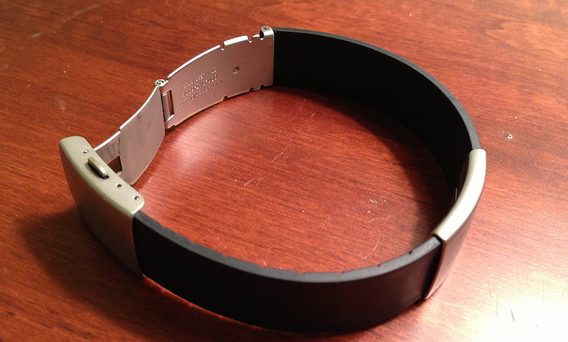
Road ID Elite silicone wrist band review


I bought the Road ID “Wrist ID Elite” silicone band not long after this model was introduced. Maybe 2011? In fact, the one I bought was so new to market that it had some kind of flaw in the catch mechanism, which led Road ID to send out a replacement mechanism for free, along with instructions on how to fix the band. I remember at the time that I was super impressed by how good the instructions were — they even included a really clear YouTube video to go with them. I swapped out my catch in just a few minutes, and the band has been working fine ever since.

If you’ve ever watched the Tour de France on television or flipped through a cycling magazine, you are probably familiar with Road ID. They have a cool backstory where the founder had been told by his dad to always carry ID when he ran and didn’t because of the inconvenience. Then he was almost run over by a car, and decided that he would figure out a way to make it easy to wear your identification instead of having to carry it around while you are exercising.

The company has a ton of different options now. They have IDs that attach to your wrist, your ankle, your shoe, as a dog tag, and even ID tags that attach to a collar for an actual dog.

The reason I went for the silicone band is because it won’t absorb sweat and won’t stink. I didn’t like the idea of the velcro band options, because I figured that it might start to smell after weeks or months of using it. I don’t know if it actually does or not, but that was why I went with silicone.

I keep my Road ID on a shelf next to my helmet, so that I always wear it whenever I ride. It doesn’t bother me when I ride, and I usually forget that it’s even there. It’s small and unobtrusive enough that it works just fine with long sleeved jerseys or with arm warmers, worn underneath.

I always carry my cell phone when I ride too, inside a plastic bag kind of thing that keeps it dry and protected. But if I were in an accident, my cell phone might get ruined, so I like the idea of a wrist band that has all of your emergency contact information and your name right there on it. I hope that I will never have to make use of my Road ID, but they have a giant testimonial page of people who have used their Road ID, which is kind of frightening to read.

I recommend the Road ID for any cyclist, or for any athlete who exercises out on the road. It is a great product that serves a very important purpose.

Review: Specialized Arm Warmers

Specialized cycling arm warmers review


When you are riding in the morning and expect the weather to warm up, or if you are just riding in changing weather conditions, arm warmers are an important cycling wear item to own.

Most of my arm warmers are pretty old and made by Pearl Izumi. I bought these Specialized arm warmers in late 2011 or possibly early 2012, and have been using them very regularly ever since.

One of the most important aspects of an arm warmer is how well it fits your arms, and whether or not it will stay up and not roll down or slide down on its own while you are riding. I wear a medium, and I have the arms of a cyclist. (Think T-Rex.)

These fit me fine, and they do not slide around or move while you are riding. One big reason for that is the terrific silicone grips at the top of the arm warmer, which you can see in the photo where I have rolled one of the arm warmers inside out to show it.

Specialized arm warmers have a left and a right arm warmer, with a little label inside so you can see which is which. I wouldn’t be able to tell the difference if it weren’t for the label, but I imagine that having two different arm warmers is also a reason why these stay on so well.

But what about warmth? These arm warmers are about the thickness of a typical arm or leg warmer, and not super thick like that Superroubaix kind of thermal fabric. They are just right for the type of temperatures that you would wear an arm warmer instead of a long sleeved jersey.

When it’s time for them to come off, they pull down pretty easily. If it isn’t windy, I can take them off while riding and put them into my back jersey pockets. You can also roll them down to your wrists and wear them like wristbands if you are starting to get hot, and not in a safe situation to take them completely off.

Silicon bands to hold shorts and jerseys and arm warmers and leg warmers in place have started to become very common on newer cycling apparel, because they are really comfortable and work well. So I usually end up wearing only these arm warmers and not my old Pearl Izumi arm warmers that don’t have any silicone, unless my Specialized arm warmers are in the wash.

As far as durability goes, these Specialized arm warmers have held up extremely well, and still seem as good as new after more than a year of owning them. The stitching and construction are both good.

I recommend these arm warmers.

At some point, I want to try out a pair of wool arm warmers since I am a fan of wool in general. But my Specialized arm warmers are so good that I can’t really justify spending the cash to buy a wool pair “just to see” if I like them as well.

Did I leave anything out? Do you have an opinion about these? Leave a comment and let me know.

Review: HEED Perpetuem Solids Long Distance Energy Chews from Hammer Nutrition

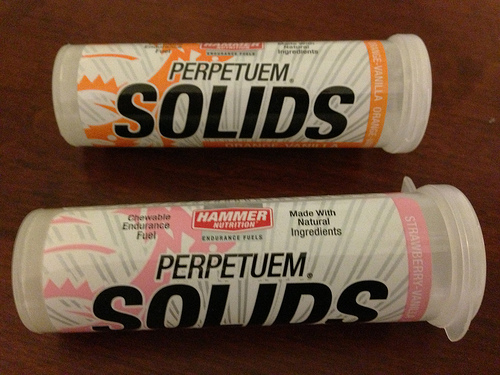
HEED perpetuem solid energy chew tablets review

I first became interested in Hammer Nutrition products in 2012, when I read a blog post by Tim Ferriss, the Four Hour Workweek guy. In that post, it mentioned how someone swears by Perpetuem by Hammer Nutrition for ultra endurance events.

So I bought some to try it out for century rides, and ended up also using it for the Leadville 100 in 2012. I use Perpetuem both in this form (the solid tablets), and as a drink mix, which I will review separately.

Perpetuem is Hammer’s energy product that is specifically designed and intended for longer periods of time. They say events longer than two hours. I’ve used these on shorter rides and they work just fine in general if that’s what is available.

The main difference is that Perpetuem has a little bit of protein in it, which supposedly makes a difference during longer events, but doesn’t really help on shorter events because your body doesn’t make use of the protein. (That’s my completely non-expert summary.)

Here’s what Hammer says about Perpetuem:

Perpetuem is a result of several years of research and thousands of miles of testing in a variety of endurance disciplines. Since its introduction in 2003, Perpetuem has allowed athletes to conquer the most extreme workouts and races with complete confidence! Perpetuem represents the ultimate, never-before-available link to satisfying the body’s fueling requirements no matter how long or difficult your exercise session or race.

Carbohydrates – As with all Hammer Nutrition fuels, we never add simple sugars to the carbohydrate profile. Perpetuem contains a specific maltodextrin, which provides nearly 87% of its caloric composition in long chain carbohydrates.

Protein – A calcium-enhanced soy protein isolate known as “XT” makes up nearly 10% of the caloric profile of Perpetuem, the same percentage that is cannibalized from muscle tissue during long, slow endurance workouts. This particular soy protein contains a very high amount of intact, cardiovascular-enhancing isoflavones.

Fat – A de-oiled “super lecithin” (extracted from the soybean) is ideal for consistently and reliably fueling the body and maximizing energy production from stored fatty acids.

The problem with the Perpetuem drink mix is that is goes bad after several hours if you premix it with water and just leave it in the bottle in warm weather.

The chews are big tablets. There are six tablets to a tube. Three tablets is 100 calories, so you get a total of 200 calories per tube, and about 33 calories per tablet.

If you read the reviews, people sometimes act like you are chewing rocks with these tablets. And Hammer has some kind of warning about delicate teeth in their description. It kind of made me hesitant to purchase the first tube.

But when I did, I found that they are no big deal at all to chew up. Much easier than something like Sweet Tarts, for example. The only thing I find slightly annoying is how they kind of stick to your teeth when you chew them.

I find the tablets to be extremely convenient, and very easy to get out of the tube. The top of the tube flips open, but is permanently attached so that you don’t lose the lid. You can keep it in your jersey pocket easily. It’s much easier than trying to open a Powerbar wrapper while you are riding, for example.

The downside is that you don’t really get very many calories per tube. If you want to consume 200 or more calories per hour, then do the math and you’ll see what I mean.

I’ve used these tablets on longer rides like the Leadville 100 and on the Shiner Gasp, with a lot of success. They provide a good source of energy, and cause zero stomach upset or problems for me.

I have not tried the Latte flavored tablets, but the strawberry and orange tablets both have acceptable taste. These are a very practical source of calories intended solely to keep you fueled, and not something that you would ever eat as a snack, like a Clif Bar, for example.

I like HEED Perpetuem in both forms, and recommend it for very long rides. I use the standard HEED drink on shorter rides of up to 50 or 60 miles, which I highly recommend and will also review separately.

Questions about this review? Did I leave anything out? Do you have anything to add? Leave a comment and let me know, and I will update accordingly.


Review: Where to Buy Prescription Cycling Glasses

My prescription Adidas Adivista cycling sunglasses in use at Leadville 100

If you wear glasses and do not wear contacts like me, then cycling can be a drag. Regular prescription glasses may or may not work well when you are riding at 20+ mph. There’s nothing worse than a pair of regular glasses that seem to channel air right into your eyeballs.

In spite of this, I never wore any kind of prescription cycling sunglasses until the summer of 2012. The main issue for me was astigmatism. I tried a pair of bicycling glasses four or five years ago, and the shaped lenses gave me a serious fishbowl effect because of my astigmatism. I spent probably $500, and I couldn’t even wear them.

But last year, I rode the Leadville 100 mountain bike race. I attended the CTS Leadville camp in early August, and it quickly became apparent that at over 10,000 feet of elevation in Colorado, the sun was extremely bright and hard on my eyes. I was going to have to find some kind of solution for sunglasses.

A friend of mine told me about an online store that specialized in prescription glasses for various sports, including cycling, ADS Sports Eyewear. It just so happened that this store is located in the Dallas area. When I mentioned my astigmatism issue, he said that this store used a special technology to make their lenses called “Freeform Digital Lens Surfacing.” Actually, I think he just called it digital lens, but that’s what he was referring to. He told me that this kind of lens also worked with astigmatism.

I was skeptical, after my very expensive failure buying standard prescription lenses several years before. The last thing I wanted to do is spend another $500+ and end up with glasses that I couldn’t wear.

But I had to have some kind of solution, so I decided to call this store on the phone and see if I could come in. Turns out that their online store is also a regular prescription glasses store right off the George Bush Turnpike, near I-75.

The store had a small showroom with a very big selection of sports specific prescription eyewear. I saw prescription sunglasses for motorcycle riding, prescription goggles for skiing, prescription goggles for racquetball and tennis and more.

The saleswoman was very knowledgable, and initially suggested some Oakley Half Jacket sunglasses. They didn’t fit me very well though, and rubbed against my eyebrows, so we ended up trying on Adidas, and I ended up with the Adidas Adivista, which has adjustable arms on the sunglasses so that I can adjust them where they don’t make contact with my eyebrows.

I talked to the saleswoman about my astigmatism issue, and that I was seriously concerned that I was about to spend hundreds of dollars on prescription sunglasses that might not work for me. She told me that she had astigmatism too, and that she had a pair of digital lens sunglasses herself, and that they really did work. If they didn’t, then they had a good return policy for prescription sunglasses.

So I took the plunge, gave her my new prescription I had just gotten from my optometrist, and bought the glasses.

I ended up buying transition lenses that are clear in the dark, and get dark when UV light hits them. The disadvantage with transition lenses is that they WILL NOT work inside a car, because car windows block UV light, so the lenses won’t ever turn dark. But since I often ride at 6 a.m. with a headlight, I wanted a pair of prescription sunglasses that I could wear early in the morning as well as when the sun was up. So that was a limitation that I was willing to accept.

A couple of weeks later, the sunglasses were ready, and I went to pick them up. They handed them to me to take outside and try, and gave me a slip of paper that explains how your brain needs to adapt to new glasses, and that it can take a week or longer. The saleswoman hadn’t mentioned this, so I was immediately worried that the glasses weren’t going to work for me and it was going to be a repeat of my previous experience.

But here’s the awesome news. I went outside and put them on, and although they were different than my regular glasses and seemed a little bit weird, they did not have the fishbowl effect! I was able to drive home wearing them without a problem, and was able to ride with them the next day.

The weirdness wore off in a few days, and I now go back and forth between my regular glasses and these sunglasses daily, and don’t notice a difference anymore. So that digital lens stuff is legit!

That photo at the top of the post is me, wearing the sunglasses at Leadville. Success!

ADS Sports Eyewear did not ask me to write a review, and probably doesn’t even know who I am. I paid the full retail cost of the glasses that I purchased from them. I don’t think they have an affiliate program, and I don’t receive any kind of compensation for recommending them. I am writing this review to help others who might be looking for prescription cycling sunglasses, like I was last summer.
Review: Smartwool Headliner wool under helmet hat

Smartwool headliner wool cycling hat under helmet

I’ve been using the Smartwool Headliner Merino wool hat as a helmet liner for two winter seasons now. I bought it at full retail.

As you can tell from the name, “Headliner,” this hat is designed to be very thin so that it can fit under a bicycle helmet. I usually don’t have to adjust my helmet at all when I wear this hat, compared to my thicker polypropylene hat that I wear when the temperature drops below 35.

Wool is a terrific insulator, and works pretty well in both hot and cool settings in general. As a helmet liner, it starts to feel pretty toasty to me above 55 degrees, but I usually have a relatively warm head and warm hands.

Down to around 35 degrees, I found this liner to be warm enough. Once it gets below that, my ears don’t quite stay warm enough. For others who have cold ears or a cold head, you might want to adjust upwards 5 degrees from my usage.

The wool hat does not itch. It is made from Merino wool, which is a finer wool than standard wool. You can machine wash the hat. I wash it in cold and let it dry by hanging it out. I only wash mine every couple of weeks or so. One of the other great features of wool is that it doesn’t pick up stink. So even if I ride hard and sweat in the hat and put it next to my bike helmet to dry out, I can take a big sniff the next day and there will be no smell.

It features “single layer interlock knit construction, and a
contoured 3 panel design with clean finish flatlock seams,” as described by the manufacturer. I think what that means in plain English is that it is one thin layer of wool, sewn together in three panels so that it fits on your head right.

This would make a good hat for runners who want something really thin that won’t cause overheating.

The hat sits relatively high on your forehead, so it won’t impede your vision while cycling. The sides of the liner are designed to come down and just barely cover your ears, and that’s how it fits for me. I wear Adidas prescription cycling glasses, and I can either wear it with the glasses over the outside of the helmet liner, or under the liner.

If you read my wool cycling socks review, you might have noticed that my Smartwool socks made the bottom of the list in that review. But unlike those socks, I really like this helmet liner / super thin wool hat and fully recommend it.

Did I leave anything out? Have a question about this product? Do you own this product and like it or dislike it? Leave a comment and let me know so I can respond and update the review.