Review: Halo II Sweat Band for Cycling

Halo 2 ii sweat band for cycling bicycling

If you do a lot of road cycling or mountain biking when the weather is warm, then you’ve probably run into the issue of sweat from your head and helmet running into your eyes or splattering the inside of your glasses or sunglasses.

I wear prescription glasses or prescription sunglasses, and I absolutely hate it when I drip sweat on the inside of the lens because I am looking down as I am pedaling. You can’t wipe off the sweat drops because they are on the inside! Even worse is when the sweat drips into your eyes and burns like crazy. If I am carrying a water bottle, I will try to squirt my face clean to stop the burning. But if I’m riding with an energy drink, I can’t.

I used to ride with a regular headband that I picked up somewhere. It was an old Camelbak band that tied in a knot in the back and said Hydrate or Die on it. It did a good job except when it was really hot or if a ride was longer, and then I would sweat through the band and get sweat in my eyes or on my glasses anyway.

The Halo II Sweat Band is one of the greatest inventions in cycling accessories, as far as I am concerned.

First of all, it is one size fits all up to 7 1/4″ hat size, so you don’t have to tie the back of it in a knot. You just put in on your head and it’s on. It’s made in the USA.

Next, it is made of a thicker fabric that they call Dryline, which does a great job of soaking up sweat. It’s not so thick that it bothers you or causes a problem wearing it under your helmet. But it’s thick enough to capture a pretty good amount of sweat.

The Dryline fabric is treated with this silver ion antimicrobial stuff that prevents it from stinking. I can tell you that it works. I usually just wash mine out under the sink with plain water after a ride and hang it to try, and only wash it in the washing machine once a month or so. But neither of mine have any kind of smell if you sniff them.

The headband is 2 inches wide in the front to capture a lot of sweat, but it tapers into a smaller strip in the back so that it isn’t a giant strap on the back of your head. It comes in many different colors.

I find it very comfortable, and have ridden with it for just under 12 hours straight during the Leadville 100 mountain bike race without any problems.

The absolute best feature of Halo sweatbands is that yellow band you see that is inside the sweatband. They call it a “patented SweatBlock Seal.” It’s a kind of plastic like material, but it is still comfortable against your forehead. What the band does is channel sweat down the side of your face or back of your head instead of letting it run into your eyes, when the headband gets completely soaked with sweat.

It works, and it works well.

If you’ve ever cursed the burning feeling of sweat in your eyes, you need this sweatband, and you should buy it. It is truly awesome. If you’d like to see a video demonstration, the manufacturer has one on YouTube that shows how it works.

One tip for keeping the headband for a long time is to never fold the sweatband so that it bends the plastic strip, because the plastic strip can break if you bend it back and forth a lot, ruining the headband.

Questions about the review? Did I leave anything out? Leave a comment and let me know so I can update.

Review: Koki TukTuk Large Bicycle Seat Bag

Koki Tuktuk large bicycle seat bag review

I purchased the Koki TukTuk large bicycle seat bag in the spring of 2012, because I was looking for something very specific in a bike bag at the time. I was planning to ride the Shiner GASP 100, and I wanted to be able to fit two tubes, three CO2 cartridges and a patch kit inside my bag, along with two tire levers and a basic bike tool.

You see, the year before in 2011, I was riding with the lead group and flatted at mile 75 or so, and ended up riding the last 20 miles alone until a guy eventually caught me and I finished up with him. I flatted coming into a small town and rode my flat rear tire gingerly until I saw a spectator in a pickup who ended up having a floor pump, which allowed me to change my flat in just a minute or two. (I was carrying one of those tiny emergency pumps and would have taken 10 minutes at least to get enough air in my tire if I hadn’t found that spectator.)

In 2012, I not only had brand new tires, but tubes and CO2 cartridges to spare for the Shiner ride! Turned out in 2012 that I finished with the lead group of about six guys, with no mechanicals, so I didn’t need any of the extra stuff. But I sure had it ready in case I did.

So let’s talk about the bag.

It’s a very big bag, but it’s narrow and long, so it doesn’t rub against your legs when you are pedaling, and that is why I liked it. I also liked the very easy way that it attaches to the seat rails and seatpost. Velcro straps for the seat rails, and a rubber thing that goes around the seatpost and hooks back to the bag. Easy to take on and off, and also reliable and stable.

The inside of the bag is one big cavity, so it’s easy to arrange all your stuff inside. They also have a little keychain fob thing that you can attach to your keys, which means that even if you accidentally leave the bag unzipped and stuff falls out, your keys will still be secure! You’d probably hear the rattling, which would alert you to your problem.

The manufacturer describes the size this way:

SIZE :: 8×3.5×3 in
VOL :: ~80 in3
WT  :: 4 oz

Koki also makes a smaller “standard” version of this bag, which would be more suitable if you wanted to carry the typical single tube and basic tool assortment.

This bag is great, except for one major flaw, in my opinion.

If you look at the bag flap of the bag, you’ll see my problem with this bike seat bag. The rubber strap on the back that is described as a “rear blinky spider” is made out of rubber that is too soft and stretchy and not strong enough. I have three bikes and one blinky, so I have to move my blinker between bags and bikes. It was only after a few times of taking off my blinker that the strap broke, forcing me to clip my blinker on my jersey whenever I use that bag.

If you use a rear blinker and plan to take it on and off this bag, I’d say it is probably a deal killer. Other than that flaw though, the bag is a terrific large sized bag with lots of room in it. It’s well made in general, aside from the rear blinker strap.

Did I leave anything out? Leave a comment and let me know so I can update.


Review: Chamois Butt’r skin cream for bicycling

Chamois Butter skin cream for cycling

Until last year, I never used any kind of skin lubricant / chamois cream for cycling. I can finish a century ride without a lot of discomfort, so it seemed like a waste of money to me.

But in 2012, I rode the Leadville 100, which takes anywhere from under nine hours to twelve hours to finish. (It ended up taking me 11:42, but I finished and got my buckle!) That’s a lot of saddle time.

Knowing that I was in for a long day, I bought a tube of Chamois Butt’r skin lubricant, and started trying it out on other rides before I used it on race day. I wasn’t sure if it was the best chamois cream, but I knew it was a very popular one, so it seemed like a good one to try.

There are a lot of different products in this category, with a lot of “clever” names like DZ Nuts, Enzo’s Buttonhole Cream, Assos (I know, it’s an entire cycling brand, but still), Belgian Budder, Nubutte, Hoo Ha Ride Glide and plenty of others like these written up at Bicycling magazine.

I haven’t tried all the other brands, so I don’t know if there’s a significant difference between them, or if they all work pretty similarly.

But I can tell you that Chamois Butt’r works just great, and caused zero negative issues for me. If you do have friction issues from your bicycle saddle, then this might be a great solution for you. I put it on and forgot about it, and successfully rode for almost 12 hours with no saddle sores later.

It is non greasy, and it washes out of your shorts (and off your skin) just fine. It contains no paraben. It has no detectible smell.

You can apply it directly to your butt, or you can rub it onto the chamois of your cycling shorts. I use about a quarter sized amount in my hand, or maybe a little more than that.

I bought one big tube and only apply it once during any ride, but I have read that among recreational cyclists who are doing longer rides, it is popular to carry the individual packets and reapply later in your ride for additional comfort. Sounds like overkill to me.

What’s it made of? Here’s from the ingredient list.

Ingredients: Water, Mineral Oil, Ethylene Glycol Monostearate, Stearic Acid, Cetearyl Alcohol, Stearyl Alcohol, Propylene Glycol, Sorbitol, Vitamin E, Vitamins A and D, Propylparaben, Methylparaben, Sodium Hydroxide, Aloe, Lanolin.

Did I leave anything out? Leave a comment and let me know, and I will update the review.


Review: Mavic Rush cross country mountain biking shoes

Mavic Rush cross country mountain biking shoes review

I have been riding Mavic Rush cross country mountain bike shoes since the fall of 2012, through a whole season of cyclocross and some mountain biking.

The reason I bought new mountain biking / cyclocross shoes in the first place is that I have been having pain on the ball of my left foot for an extended period of time, and decided that I would try buying new road and mountain biking shoes (and a new cleat position) to see if that solved my problem before I give up and go to the doctor.

I went to two local bike shops here in Dallas — Richardson Bike Mart and Dallas Bike Works. I tried on every pair of high end to mid range mountain biking shoes that they carried, looking for the most comfortable fit. Although a comfortable fit in the store doesn’t guarantee that they will be comfortable while pedaling, I wanted to at least see if they were hurting the ball of my foot when I tried them on in the store and avoided shoes that did.

I typically ride high end shoes, and was hoping that something like the top end Mavic Fury might work for me. The Fury shoes were also comfortable, but I could feel the heel of my foot slipping when I walked in the Fury, which would not be acceptable for running during cyclocross racing. The Rush shoes did not have this issue for me. (The fact the my heel slipped in them doesn’t mean that everyone’s heel will slip! I have relatively narrow heels.)

The Mavic Rush shoes have a good ratchet system at the top of the shoe to make sure that your shoes stay on at exactly the tightness that you require. The ratchet works well and doesn’t slip, and has held up well for me so far. To release them, you grab a little lever and pull outward, and they come right off.

The bottom two straps are Velcro. I typically keep the very bottom strap always strapped shut, because I can slip in and out of the shoes by loosening the top and middle straps. The Velcro for the middle strap is good quality, and has held up fine coming on and off. One issue I notice with the middle strap is that when I tighten it in the house, I can feet a small lump on the top of my foot. But when I stand up and when I click into the pedals, I no longer feel this and have no comfort issues with the shoe during riding and running with them.

The footbed of the Mavic Rush shoes are very comfortable, and I was able to pedal and run in these shoes comfortably.

Outsole bottom of Mavic Rush cross country maountain biking shoes with spd cleats

The “Energy Grip Outsole” of these shoes is not carbon like the Mavic Fury, but it feels plenty stiff to me. Comfort was more important to me than stiffness in this situation, particularly since I also use the shoes for cyclocross racing and run in them and jump over barriers. As you can see from the photo, you can also attach spikes to the front of the shoes if you are racing in mud or ice.

The cleats on the shoes and the “Contagrip” rubber on the bottom make them very good for running without slipping. If you’ve ever had a pair of mountain biking shoes that don’t grip, you probably know how that can suck when you’re trying to run your bike up something rocky or muddy and slippery.

As far as temperature goes, I haven’t ridden them in the summer yet, but I have ridden them on 80 degree plus days with no heat issues. And down to the mid 40s, I am fine with wool socks. Under 45 degrees, I’ll usually add neoprene toe caps to the wool socks to keep warm.

There is plenty of room in the toe box of these shoes, and I am able to ride with thicker wool socks when the weather gets cold.

These shoes are usually priced around $129. I think I paid $129 locally. So they are a very good value, especially compared to the high end Fury that costs more than $300. Bicycling Magazine agrees with me on the issue of comfort and affordability.

Did I leave anything out with this review? Leave a comment and ask me a question or let me know what else I should include, and I will update the review accordingly.


Best Wool Cycling Socks: The Shootout

wool cycling socks

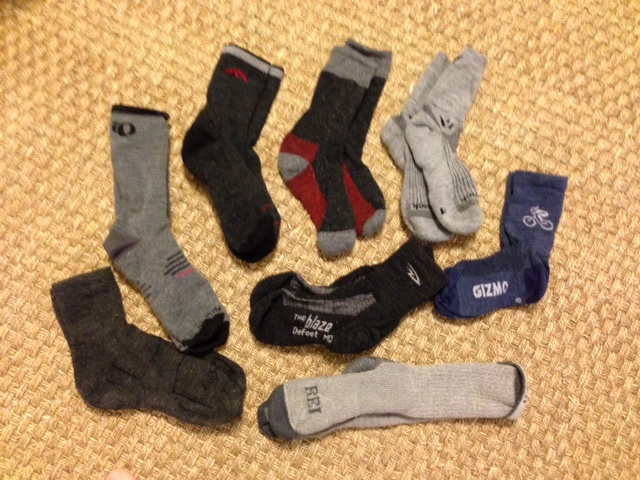
Looking for the best wool cycling socks? I was too. I checked my sock drawer recently and realized that I might have gotten a little bit obsessed during my search for the best wool socks. I bought every single pair of these at retail, over a period of a couple of years.

I figured that I would share what I had learned so that everyone else won’t have to spend as much money on socks as I did.

If you don’t care to read about every different pair of socks and just want to know which ones are good, then I will give you the best first.

It’s really almost a four way tie, because there are four pair that I totally love. In fact, I’m happy with all of these socks listed and wear them all regularly, except for the Smartwool socks, which have not held up well in the wash compared to all the others.

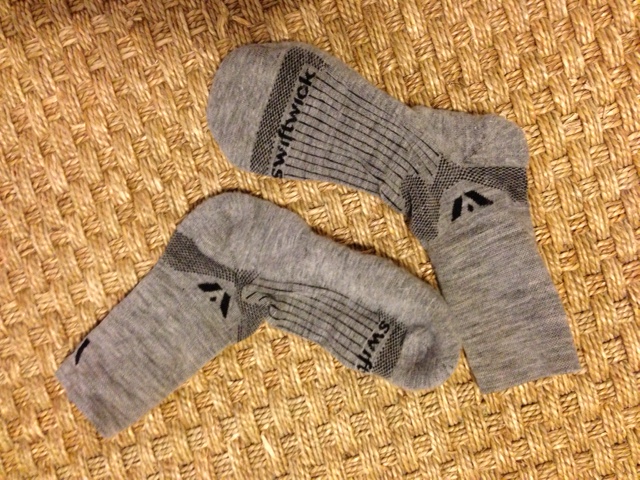
swift wick pursuit 4 merino wool socks review

If I had to pick just one pair as the best, I’d choose the Swiftwick Pursuit 4 merino wool socks. First of all, they have an outstanding fit that’s really snug. Swiftwick describes them as compression socks, to give you an idea. The wool is not itchy. The breakdown is 60% merino wool, 30% nylon, and 10% lycra. You’ll get just the right amount of padding for your foot, and a sock that holds up extremely well in the wash.

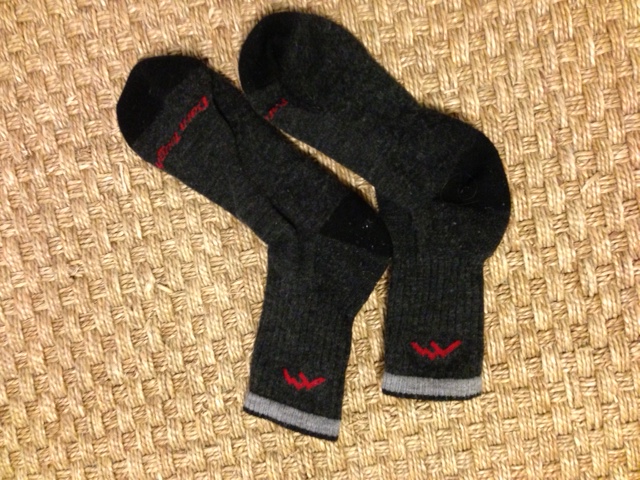
Darn Tough Vermont Merino Wool Socks review

One of my other top four wool cycling socks isn’t a cycling specific sock at all. It’s the Darn Tough Vermont Merino Micro Crew. These socks all work great as a standard pair of dark socks, so you get dual use out of them. The Darn Tough brand is made in the USA, in Vermont. 67% Merino Wool, 29% Nylon, 4% Lycra / Spandex. They have outstanding build quality, good padding, and they hold up great in the wash. If you want a wool sock that you can wear when you’re on and off the bike, these socks are the way to go.

sockguy wooligan cycling socks review

My Sockguy Wooligan cycling socks are in my “top four pretty much tied for first” list of favorite wool socks. I also bought a thinner standard wool cycling Sockguy pair of socks that are similarly well made and comfortable. Good pricing, outstanding quality, terrific fit, and holds up well in the wash. Sockguy calls his type of wool Turbowool. “Made with 75% TURBOwool, a superior blend of 50% polypropylene and 50% Merino wool, which provides five times the strength and durability of Merino wool alone.” So what that really means is that the “75 percent Turbowool” really means around 37 percent wool content of the entire sock. Still, these socks are great.

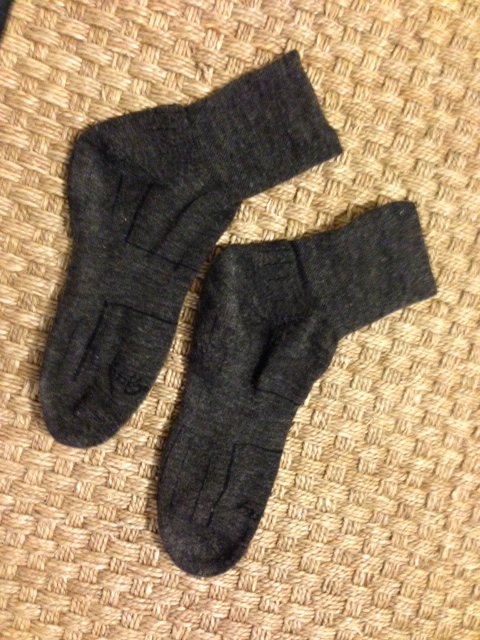
Pearlizumi elite thermal wool cycling sock review

Also in my “four way tie for first place” is this pair of Pearlizumi Elite Thermal Wool Cycling Socks. I haven’t had these socks for a long time, but they are holding up very well in the wash so far. The high nylon content tells me that they should be pretty durable. They are just the right thickness for winter, but should also do well as the weather starts to warm up. Wool really does work well in hot and cold. These socks come up pretty high, and are also suitable as a dress sock or casual sock if you get a plain pair like I have.  49% nylon, 48% Merino Wool, 3% spandex.

defeet blaze wool cycling socks review

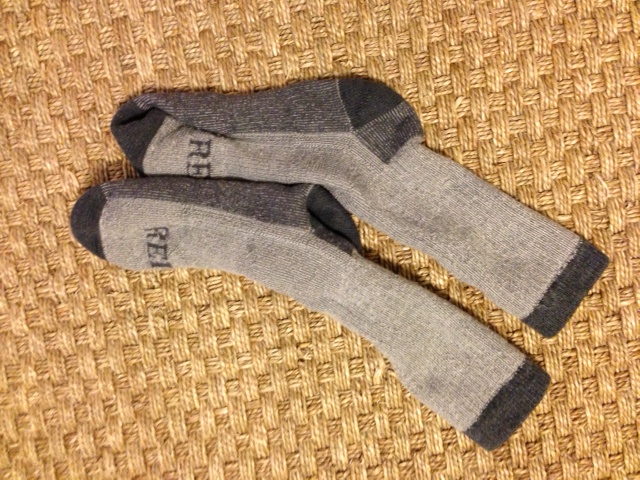
My Blaze wool socks by Defeet have the thickest padding of all my socks except maybe for my REI midweight wool hiking socks. I’m not sure if they are calling these the Woolie Boolie now, or if that is a different sock. 63% Wool 27% Nylon 10% Lycra Spandex. The wool in these socks doesn’t say Merino, so I’m not sure if it is. They are a little bit more course than my other wool cycling socks, but I would not describe them as itchy. Even with the high percentage of wool, these have really held up well in the wash.

REI wool hiking socks review

My REI wool socks are actually hiking socks, and not cycling socks at all. They are thicker than my other cycling socks, so I often wear them when the temperature is colder. If you have very snug cycling shoes, these might be a little bit too thick. They have a very high wool content, which makes them warm. But I also wear them in warm weather off the bike, and they don’t get too hot. REI only puts their name on quality stuff, in my experience, and these socks are great. I also wear them hunting and hiking. They are cheap too, at around $13. 78% wool/20% nylon/2% Lycra spandex.

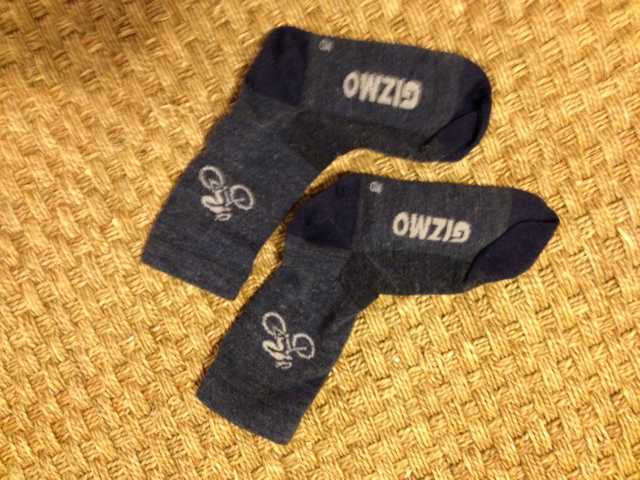
gizmo wooly-g merino socks review

I picked up my Gizmo Wooly-G cycling socks at Richardson Bike Mart. They have held up well in the wash and are adequate socks, but one of my least favorite pair. They are thinner than most of my other wool cycling socks, so they are great summer wool socks and okay winter socks. I like a little bit more padding in the sole than these socks provide. If you like thin and durable though, you can’t go wrong with these. I think it’s the high percentage of nylon that makes them hold up so well. 55% Merino Wool 40% Nylon 5% Lycra.


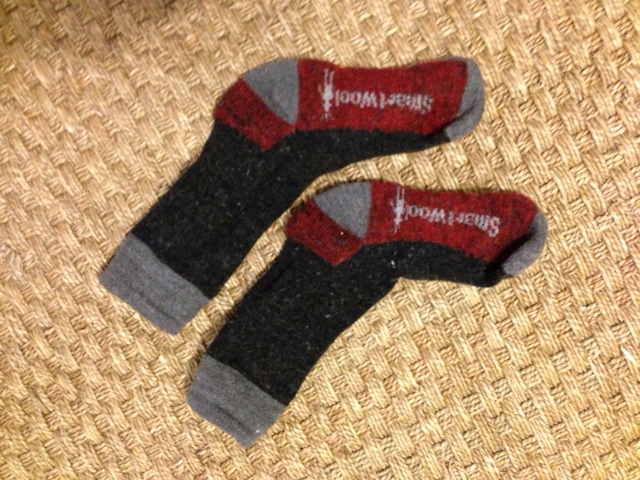
smartwool hiking socks

My worst pair of wool cycling socks is my Smartwool socks. I don’t know why these have become so baggy and frayed over time, while all my other wool socks have held up. Perhaps it is the low percentage of elastic material in these socks. I’m a fan of Smartwool in general. I wear my Smartwool hoodie all the time, and my Smartwool midweight base layer is one of my favorite winter base layers for cycling or any other outdoor activity. 74% merino wool, 25% nylon, 1% elastic. I do not recommend these.

What’s your favorite pair of wool cycling socks? Have you tried any of these? Leave a comment and share your experience to help everyone else shopping for socks.